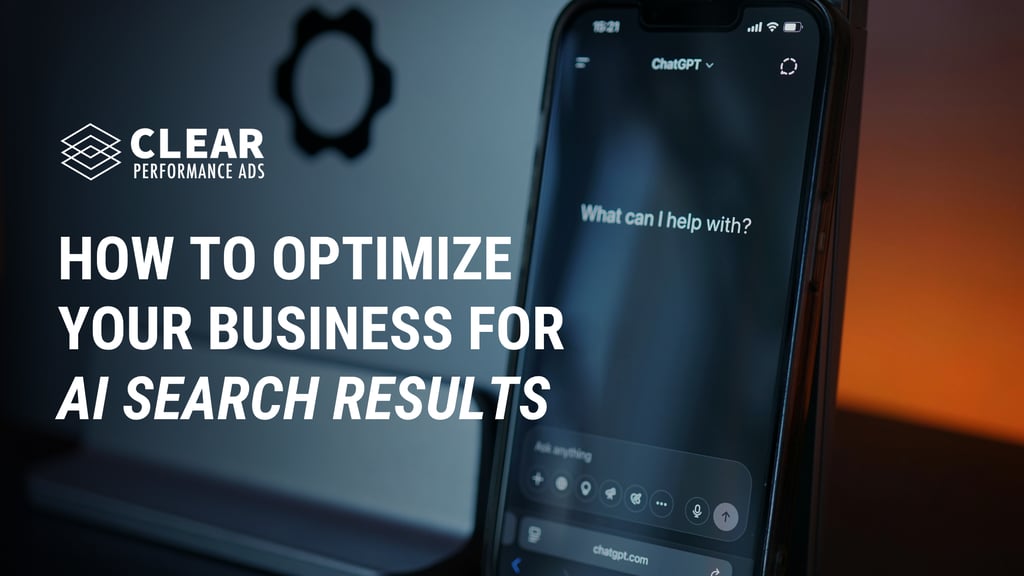
How to Optimize Your Business for AI Search Results
ChatGPT, Perplexity, and Google AI Overviews are changing how customers find businesses. Here's exactly what to do about it.
If you've noticed a dip in organic website traffic over the past year, you're not imagining it. According to Search Engine Land, 37% of consumers now start their research with an AI tool rather than Google. And Bain & Company research found that nearly 60% of searches now end without a single click — because the AI answered the question directly on the page.
This shift has a name: Generative Engine Optimization (GEO) — also called Answer Engine Optimization (AEO). And for small businesses in Michigan and beyond, getting ahead of it now is one of the highest-leverage things you can do for your digital marketing strategy in 2026.
This guide breaks down exactly what AI search is, why it matters for your business, and the concrete steps you can take to show up, even if you're competing against much larger brands.
Traditional SEO was about ranking on Page 1. In 2026, the new goal is being the source AI engines cite when they answer your customers' questions, before those customers ever click a link.
37%
of consumers now start searches with AI instead of Google
What Is AI Search, And Why Does It Matter for Small Businesses?
Traditional search engines like Google showed you a list of ten blue links. You clicked the one that looked most relevant. AI search engines do something fundamentally different: they read multiple sources, synthesize the information, and deliver a direct answer — sometimes with citations, sometimes without.
The major players right now include:
How AI Engines Decide What to Cite
Before you can optimize for AI search, you need to understand how these systems choose their sources. Search Engine Land's GEO guide explains it clearly: AI engines are not just indexing your content — they're evaluating it for credibility, clarity, and relevance before deciding whether to cite it.
The core factors AI systems weight most heavily are:
Clarity and structure — content that's organized with clear headings, short paragraphs, and direct answers to questions
Recency — A 2025 Ahrefs study found that the average AI-cited page is nearly a full year newer than pages appearing in traditional search results
Specificity and data — concrete statistics and specific claims get cited far more than vague, general statements
Structured data (schema markup) — pages with proper schema have a 2–3x higher chance of appearing in AI-generated answers
Third-party authority — being mentioned in external, authoritative sources signals trustworthiness
⚠️ The Zero-Click Reality
When an AI answers a question about your industry without citing your business, your competitor gets the mental real estate, even if they never appear in the actual answer. Brand awareness is being built by AI recommendations now, not just ad placements. That's why a combined AI + paid ads strategy is becoming the new standard for competitive businesses.
6 Steps to Optimize Your Business for AI Search
STEP 1 — MAKE SURE AI CRAWLERS CAN ACTUALLY ACCESS YOUR SITE
Before anything else, confirm that AI bots can reach your pages. Check your robots.txt file (at yoursite.com/robots.txt) for blocks against crawlers like GPTBot, PerplexityBot, and ClaudeBot. If you see "Disallow: /" for these bots, you're invisible to AI search.
Quick test: Search your business name and core topics directly in ChatGPT and Perplexity. If you never appear as a source, start your investigation here.
STEP 2 — WRITE CONTENT THAT DIRECTLY ANSWERS QUESTIONS
AI engines love content that leads with the answer. Directive Consulting's research found that only 8% of one-to-two word queries trigger AI summaries, but question-style, long-form searches almost always do.
Structure your blog posts and service pages as direct answers to the questions your customers are actually asking. Replace vague claims with specific data:
❌ Weak: "We help businesses grow their revenue."
✅ Strong: "Our clients see an average 3.2x ROAS improvement within 90 days of campaign launch."
The more specific and verifiable your claims, the more trustworthy your content appears to AI systems.
STEP 3 — IMPLEMENT SCHEMA MARKUP (STRUCTURED DATA)
This is the single most technically impactful step you can take. Schema markup gives AI engines a machine-readable "translation" of your content, telling them exactly what your business is, what services you offer, where you're located, and what customers say about you.
For small businesses, prioritize these schema types:
LocalBusiness — critical for service-area businesses and local AI queries
FAQPage — highest single impact; AI engines directly extract Q&A pairs for responses
Article — establishes content authority for every blog post
Organization — builds your entity recognition across AI platforms
Validate your schema using Google's free Rich Results Test.
STEP 4 — KEEP YOUR CONTENT FRESH AND DATED
AI systems strongly favor recent content. As Search Engine Land put it: "ChatGPT prioritizes RECENT over PERFECT. That amazing guide from 2022? It's losing to mediocre content published yesterday."
Display a clear "Last Updated" timestamp on every important page
Refresh your top 5–10 pages every quarter — update stats, revise examples, add new insights
Plan your next revision date before you even hit publish
STEP 5 — BUILD YOUR LOCAL ENTITY PRESENCE
For local businesses, local SEO and AI search optimization are deeply connected. Brightly's 2026 local SEO research found that local search signals are the building blocks AI engines use to understand and recommend service-area businesses.
Key actions:
Complete and regularly update your Google Business Profile
Maintain consistent Name, Address, and Phone (NAP) data across every directory
Actively collect customer reviews, AI platforms cross-reference review signals when deciding whether to cite a local business
STEP 6 — EARN THIRD-PARTY MENTIONS AND CITATIONS
Princeton research cited in Search Engine Land's GEO guide shows that AI engines strongly favor earned media — mentions in authoritative third-party sources — over brand-owned content. This means getting featured in local publications, industry directories, partner websites, and press mentions directly boosts your AI search visibility.
Practical tactics:
Write guest posts for local or industry publications
Pursue local media coverage (Detroit Free Press, Crain's Detroit Business, etc.)
Ensure your business is listed in relevant industry directories
Build genuine partnerships with complementary local businesses
Quick Wins You Can Implement This Week
Not everything requires a developer or an agency. Here are changes any small business owner can make right now:
Search your business name on ChatGPT and Perplexity — note what comes up (or doesn't)
Add a FAQ section to your homepage and key service pages answering your most common customer questions
Update the "Published / Last Updated" date on your top 5 blog posts
Verify your Google Business Profile is 100% complete with current hours, photos, and services
Replace any vague claims on your website with specific, data-backed statements
Check yourrobots.txtfile for AI crawler blocks
Add your business to any industry-specific directories you're missing
📌 What This Means for Michigan Small Businesses
When someone in Detroit searches "best PPC agency near me" on ChatGPT, or asks Perplexity "who should I hire to run Google Ads in Michigan," the businesses that show up aren't necessarily the biggest, they're the ones whose content AI can read, trust, and cite. That's something you can control right now.
How to Measure Your AI Search Visibility
Unlike traditional SEO, you can't just check your Google rankings to see if GEO is working. AI-driven visibility requires tracking different metrics entirely. Here's what to monitor:
Citation frequency — how often your business appears as a source when you query your key topics across ChatGPT, Perplexity, and Google AI Overviews
Brand search volume — if your AI optimization is working, more people will search for your business by name over time
Referral traffic from AI platforms — monitor traffic sources in Google Analytics 4 for direct referrals from Perplexity, ChatGPT, and similar tools
AI Overview impressions — in Google Search Console, filter impressions to see how often your pages appear in AI Overview placements
Tools like HubSpot's free AEO Grader can give you a baseline score showing how AI platforms currently characterize your brand — which is a useful starting point before you begin optimizing.
The Bottom Line: AI Search Is Here. Get Ahead of It Now.
The businesses that will win in AI search over the next two to three years aren't the ones who start optimizing when it becomes impossible to ignore, they're the ones who start now, when the competition is still figuring out what GEO even means.
The good news: most of the foundational work clear content, structured data, a complete local presence, fresh updates — overlaps directly with solid traditional SEO. You're not starting from scratch. You're evolving an existing strategy.
If you're not sure where your business currently stands in AI search, or how to connect your AI visibility strategy to a paid advertising strategy that drives results now, our team at Clear Performance Ads can help. We work with Michigan small businesses to build data-driven, AI-ready digital marketing strategies and we'd love to start with a free audit of your current setup.
60%
of searches end without a click, AI answers the question directly
2-3x
more AI citations for pages with proper schema markup vs. those without
Here's the critical thing to understand: AI search is not just a big-brand game. Research from First Page Sage found that AI engines actually favor clear, authoritative, well-structured content — giving newer and smaller sites a genuine opportunity to gain visibility that would take years to earn in traditional SEO.
💡 How This Connects to Your Paid Ads Strategy
AI search and paid advertising aren't competing — they're complementary. Your Google Ads campaigns drive immediate traffic while your AI search presence builds organic authority over time. Businesses that invest in both create a compounding advantage: paid ads bring in leads today while GEO ensures your brand is recommended by AI tools tomorrow. See how we approach this at Clear Performance Ads →
The Biggest Mistakes Small Businesses Make With AI Search
Knowing what not to do is just as important as knowing the right steps. Here are the most common GEO mistakes we see:
Blocking AI crawlers in robots.txt — often done accidentally when copying settings from outdated templates. Check yours today.
Treating GEO as a one-time task — AI search rewards ongoing content freshness. Set a recurring maintenance schedule, not a one-and-done project.
Ignoring schema markup — the majority of small business websites have either no schema or auto-generated plugin schema that AI engines largely ignore.
Writing for the old SEO playbook — keyword-stuffed content written for algorithms performs poorly with AI. Write for humans, structure for machines.
Neglecting your Google Business Profile — for local businesses, this is one of the most powerful AI search signals available. Keep it current and complete.
Is Your Business Showing Up in AI Search?
Get a free audit covering your AI search visibility, Google Ads performance, and overall digital presence with zero obligation.
READY TO GROW SMARTER?
support@clearperformanceads.com
© 2026. All rights reserved.